
TRAVEL + EXPERIENCES
The Perfect Vacation…Designed
Joe Schnur · 3 min read
Read Article →
HOAs operate a lot like small local governments.
There are meetings, rules, budgets, vendors, maintenance issues, homeowner questions, approvals, and years of decisions to keep track of.
Yet much of that work still happens through email, Word documents, spreadsheets, portals, and institutional knowledge stored in someone's head.
AI can eventually change a lot about HOA management, but you do not have to start with the complicated stuff.
There are several practical, low-cost uses that can save time immediately, require very little behavior change, and still leave boards and property managers in control.
More HOA meetings are moving online through Zoom, Teams, and similar platforms, many of which already include AI transcription and meeting-summary capabilities.
Instead of a property manager taking notes, reconstructing the meeting afterward, writing minutes, circulating a draft, and making revisions, AI can capture the meeting as it happens and prepare the draft minutes, motions and votes, decisions, action items, and homeowner Q&A.
By the time the meeting ends, most of the documentation could already be ready for board review.
HOAs accumulate years of information: meeting minutes, homeowner questions, board decisions, vendor discussions, rules, budgets, projects, complaints, contracts, and resolutions. The information usually exists. Finding it later is the problem.
A board member could ask:
People come and go. The HOA's knowledge should remain.
A homeowner should be able to take a picture and say: "The sprinkler outside my house is broken." AI can look at the image, identify the likely problem, determine the location, and prepare a service ticket — ready for homeowner confirmation before submission.
Instead of searching PDFs or waiting for a callback, a homeowner could simply ask:
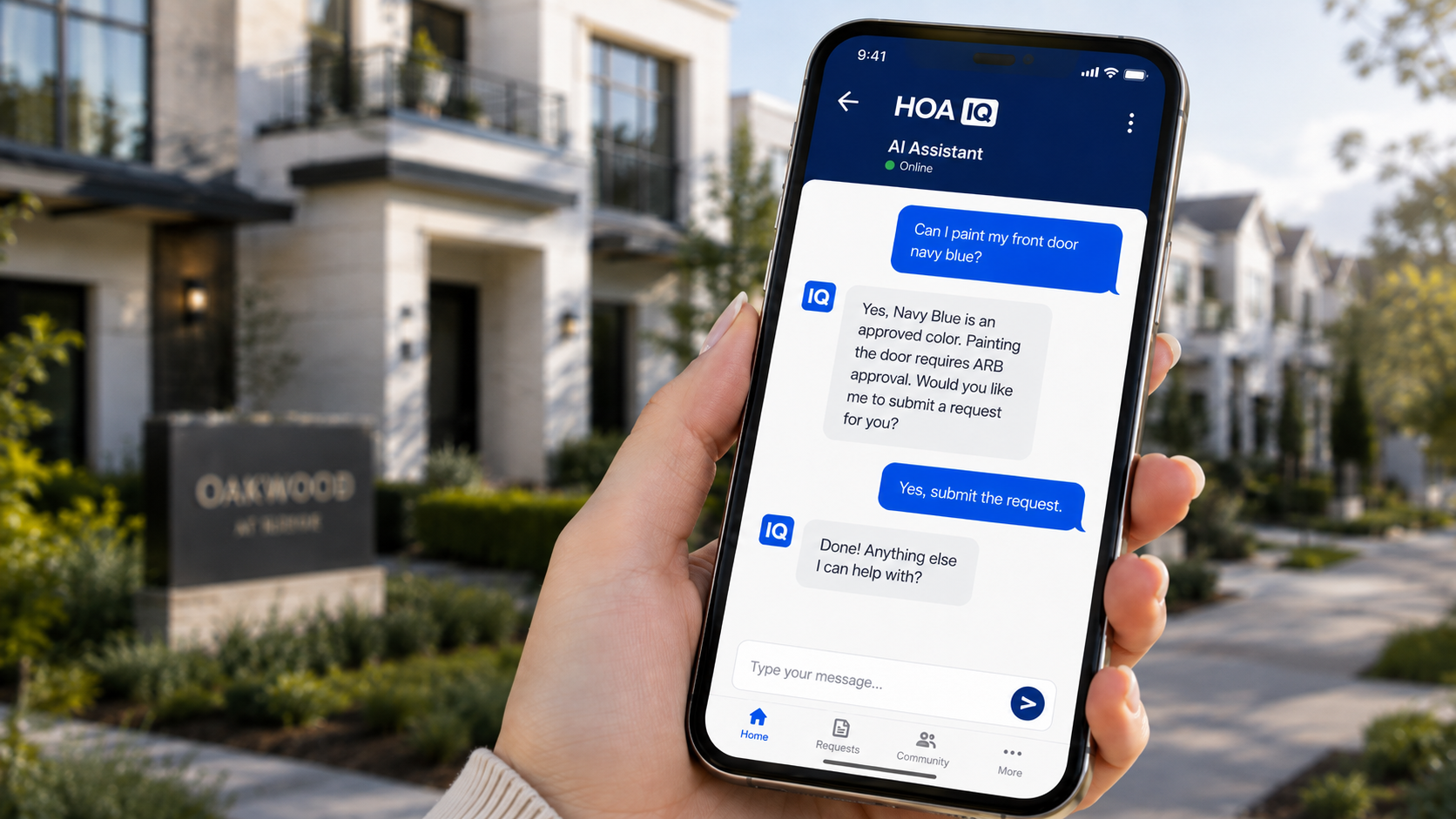
This is where AI starts moving beyond answering questions and begins helping get work done. A maintenance ticket becomes a routed, tracked, vendor-ready request. An ARB question becomes a submitted approval request.
A homeowner asks whether they need approval to add a fence. AI confirms the requirement, asks a few quick questions to gather the details, and routes the completed application to the board — the homeowner never sees a form.
Automation does not mean removing oversight. It means moving routine work forward until a human decision is actually necessary.
These five examples are intentionally simple. They remove repetitive work, make information easier to access, create better records, and help existing processes move faster.
Numbers six through ten get a lot more interesting. That is where AI starts moving beyond documentation into vendor management, financial oversight, proactive community management, and more autonomous workflows.
But those are conversations for another article.