HEALTH + LONGEVITY
Our Biology Gives Us Clues. AI Can Unlock the Message.
Joe Schnur · 4 min read
Read Article →
Before we deploy important software, we smoke-test it.
We simulate conditions, run thousands of scenarios, look for failures, and build confidence before the change reaches production.
With biology, we still do much of the opposite. We intervene in the real human, observe the response, and then adjust from there.
That is beginning to change.
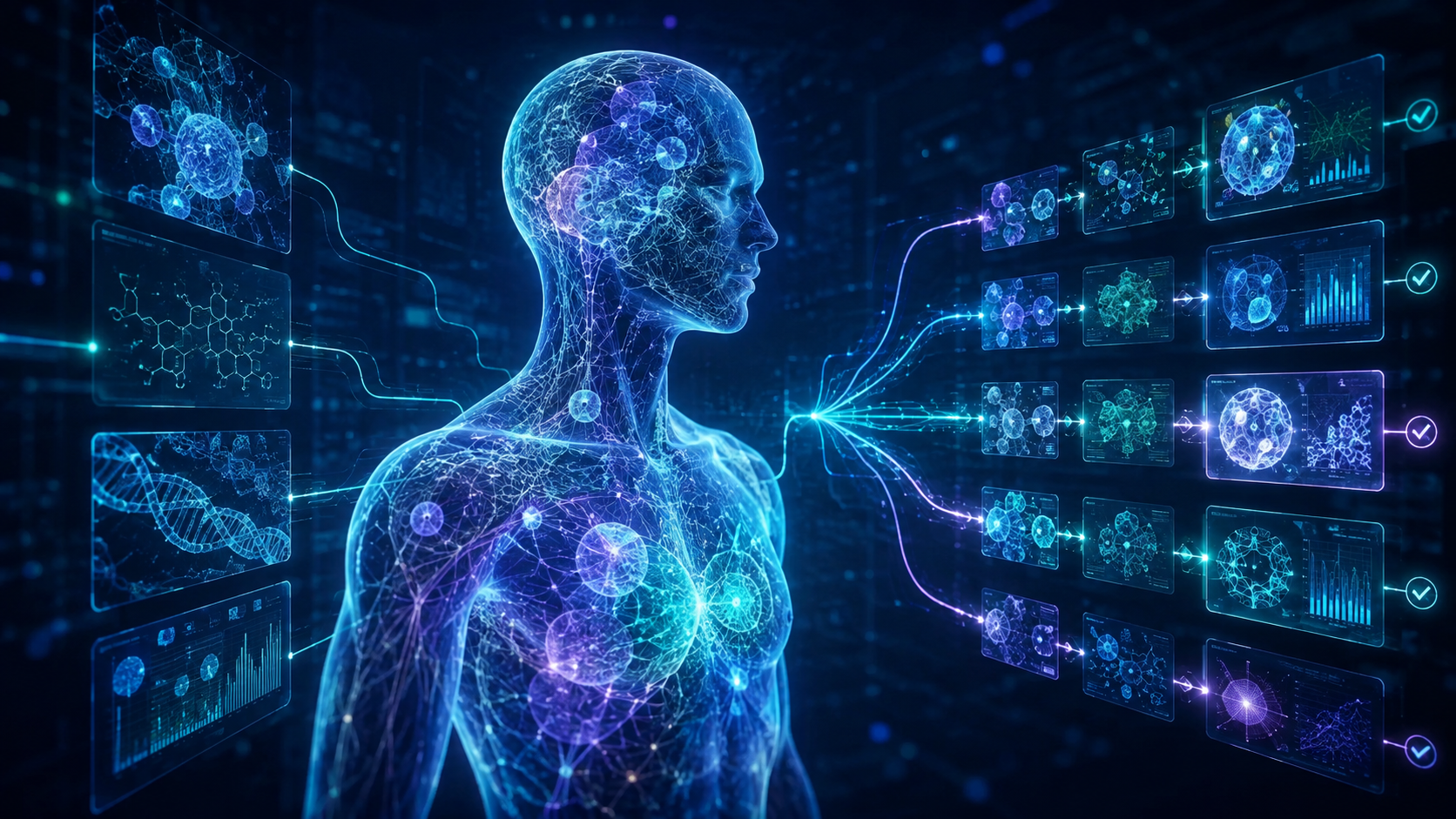
AI is opening the possibility of building increasingly accurate models of biology and testing thousands or millions of possible interventions in simulation before making a change in the real world. That is a very different way to think about health.
Companies such as GenBio.AI and ANI.ai are already working toward this future from different directions.
GenBio.AI is focused on making biology computable and simulatable across biological scales. Eric Xing, the company’s co-founder, describes the ambition this way:
“To truly understand life, we must model and simulate it across every scale.”
— Eric Xing, co-founder of GenBio.AI
ANI.ai is building from the individual outward. By generating longitudinal intervention-response data through clinical trials, it is training a whole-human world model that reconstructs biological state, predicts how it will change, and learns each person’s response to intervention.
We are obviously not at the point where we can perfectly simulate a human being. This is not quite “beam me up, Scotty.”
But the direction is increasingly clear: build a digital model of biology that becomes accurate enough to test interventions before we make them in the real person.
Today, much of medicine still relies on population averages. A treatment worked for a percentage of people in a clinical study, so someone with similar characteristics receives that treatment and we see how they respond.
Simulation changes that model.
Instead of testing only a handful of possible interventions in the real world, we could eventually test thousands or millions against a digital representation of our own biology.
Medication, nutrition, exercise, supplements, procedures, and combinations of all of them could be evaluated before we make the real-world change.
The goal is not simply more data. The goal is greater confidence that the intervention selected for the real human will produce the desired outcome.
This becomes much bigger than treating disease.
If we can simulate biology accurately enough, the same approach can influence prevention, longevity, recovery, nutrition, medicine, and everyday health decisions.
We move away from waiting until something goes wrong and then reacting to it. We move toward understanding where our biology is heading and identifying the intervention most likely to improve that trajectory.
That changes the way we think about health.
For decades, precision medicine has largely meant using more information to make a somewhat better-informed decision.
Precision biological simulation could take that much further.
Instead of asking what usually works for someone like me, we could increasingly know what is most likely to work for me.
We already demand simulation and testing before deploying changes to critical software. Our biology is infinitely more important.
Labs are already using biological simulation to test enormous numbers of possibilities in silico. The next step is bringing that same level of precision to the individual.
When we can test thousands or millions of interventions against an accurate model of our own biology before making a real-world change, it will reshape how we think about medicine, prevention, longevity, and care.
Test the simulation first. Intervene in the human second.
That is when precision health stops being a promise and starts becoming a process.